🍞 Rustic Focaccine, Crispy Outside and Soft Inside
Rustic multi-flour focaccine with rye, semolina, legumes. High-hydration direct dough, cold fermentation.
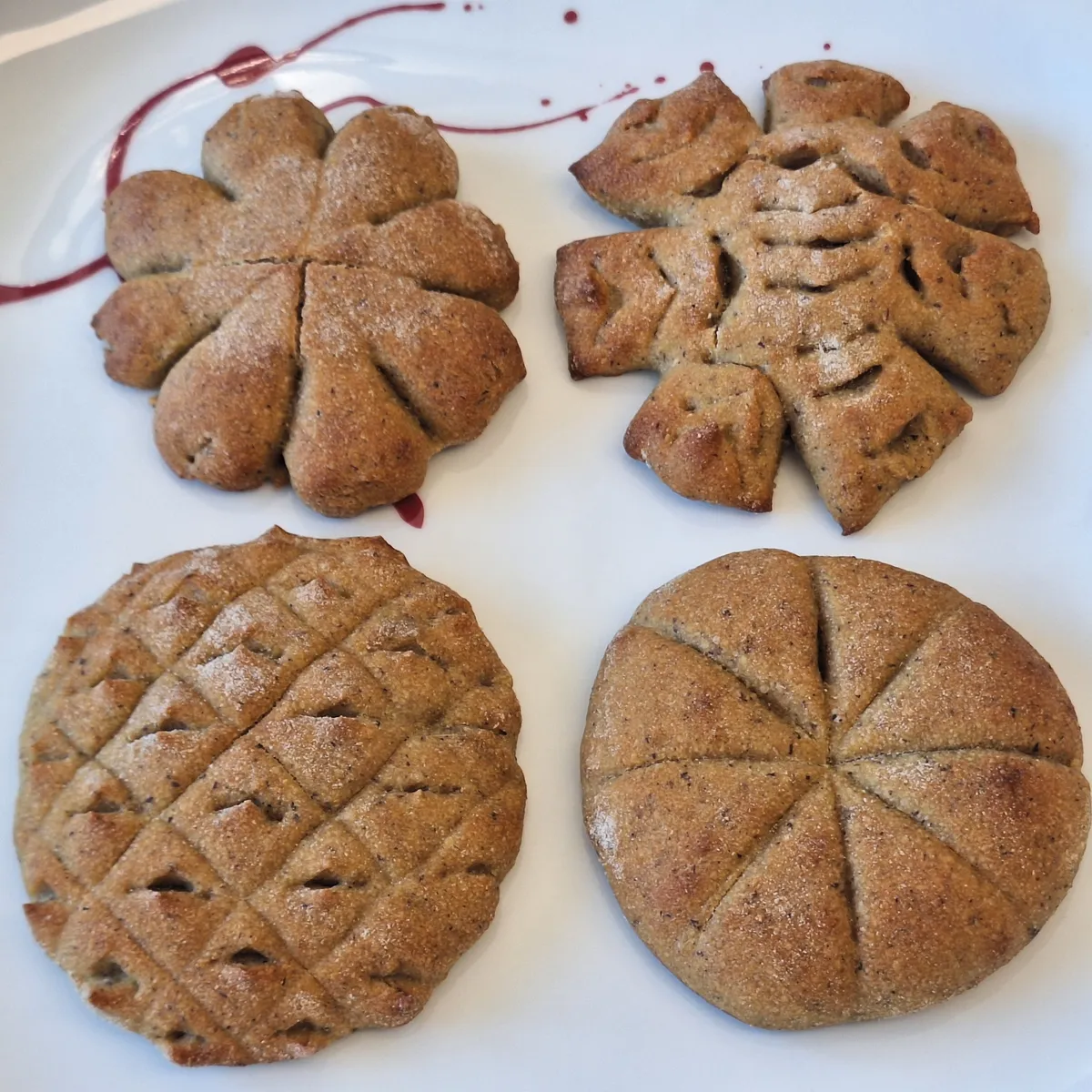
Rustic Focaccine, Crispy Outside and Soft Inside
Set the amount of ingredients you want to use with one of the two options below:
Quantity
Total flours (min g, max g):
g
Ingredients
| Ingredient | Quantity | % |
|---|---|---|
| Total flours | 1000 g | 100% |
| Strong type 1 flour | 400 g | 40% |
| Type 2 flour | 150 g | 15% |
| Re-milled durum wheat semolina | 200 g | 20% |
| Wholemeal rye flour | 170 g | 17% |
| Legumes flour (chickpea, lentil or pea) | 80 g | 8% |
| Water | 780 g | 78% |
| Fine salt | 13 g | 1.3% |
| Extra-virgin olive oil | 40 g | 4% |
| Diastatic barley malt | 5 g | 0.5% |
| Active dry yeast | 4 g | 0.4% |
Method
- Autolyse (optional but recommended): in a large bowl, combine all the flours with the water. Mix roughly until incorporated. Cover and rest 20-60 minutes. The autolyse allows the flours to fully hydrate and begins gluten development before kneading, making subsequent work shorter and the result more extensible.
- Knead: add 5 g malt and 4 g yeast (dissolved in a little water from the total). Knead for a couple of minutes to incorporate, then add 13 g salt and 40 g extra-virgin olive oil. Continue kneading until the flour and oil are fully absorbed. There is no need to achieve a smooth, round ball at this point: that will come after the first fold. Cover the bowl with a lid or a plate.
- Bulk rise: perform 3 stretch & folds every 30 minutes, then leave the dough covered at room temperature until doubled in volume.
- Cold fermentation: lightly oil the bottom of the container (optional step, but helps with releasing the dough after fermentation). Cover and refrigerate for 12-24 h (up to 48 h possible).
- Shaping: divide the dough into 50-100 g pieces. Gently flatten into discs no thicker than 1 cm. Rest covered for 45-60 minutes at room temperature.
- Optional brine: emulsify water and oil in a 1:1 ratio by beating with a fork. Brush onto the surface of the focaccine, poke holes with a fork (optional), add dried oregano to taste.
- Baking: bake at 250 °C for about 15 minutes (adjust by eye: 2-3 minutes more for a crispier crust, less for softer focaccine).
Technical Notes
- Hydration. This recipe uses 78% hydration. It can be varied from 70% up to 80%. I advise against exceeding 80% because the dough becomes significantly harder to work without noticeable benefits to the final product.
- Autolyse. This is an optional but recommended step. It consists of mixing flour and water and letting it rest for 20-60 minutes before adding salt and yeast. This time allows the flour to fully hydrate and the gluten to begin forming on its own, resulting in shorter kneading time and a more extensible, workable dough. Reserve a little water from the total to dissolve the yeast separately: it will be easier to incorporate after the autolyse.
- Role of each flour. Type 1 flour (40%) provides the structural backbone of the dough thanks to its gluten content (13-14% protein): it is the flour that gives elasticity and holds the others together. Type 2 flour (15%), semi-wholemeal, contributes a more complex flavour and a slightly nutty note, adding fibre without compromising the structure too much; it absorbs slightly more water than type 1. Re-milled semolina (20%) gives the crust its crunch, a golden colour and a "shorter" texture (less elastic, more crumbly): it is the key ingredient that sets the rustic focaccine apart from the cloud-style ones. Rye flour (17%) brings an earthy and slightly tangy flavour, absorbs 10-12% more water than white flour and has very little gluten, so it is the type 1 flour that must compensate structurally. Legume flour (8%), a blend of chickpea, lentil and pea, adds protein, a delicately sweet flavour and a slightly warmer colour, without developing gluten.
- Variations. For a smoother, less rustic dough, shift part of the type 2 towards type 1. For an even crunchier crust, shift part of the type 2 towards semolina. The balance between these three flours determines the final character of the focaccina.
- Salt. The base dose is 13 g per kg of flour (1.3%). For a bolder flavour you can go up to 20 g/kg (2%), which is still within the norm for savoury baked goods. I also tried going down to 10 g/kg and the final product is still very good, even though 10 g/kg is the amount of salt you put in bread, not in focaccia, but the aromas and flavours of the flours make up for the reduced salt. Salt should always be added after the autolyse, never in direct contact with the yeast.
- Oil. The base dose is 40 g per kg of flour (4%). It can be increased up to 60 g/kg (6%) for better palatability, a softer crumb and longer shelf life. Oil should be incorporated at the end of kneading so it does not interfere with gluten formation.
Diastatic Malt vs Sugar/Honey
| Diastatic malt | Sugar / Honey | |
|---|---|---|
| Type of nourishment | Active enzymes (alpha and beta-amylase) + simple sugars | Simple sugars only (sucrose/fructose) |
| Mechanism | Enzymes progressively break down flour starch into maltose, providing continuous nourishment to the yeast throughout fermentation (12-48 h) | Supplies immediately available sugars that yeast exhausts rapidly in the first hours |
| Osmotic effect | None | At high concentrations draws water from yeast cells by osmosis, slowing fermentation |
| Long fermentation | Ideal: steady nourishment for 24-48 h+ | Unsuitable: after the initial boost there is no more nourishment |
| Maillard reaction | Produces reducing sugars → golden and aromatic crust | Surface caramelisation (darker colour but different flavour) |
| Effect on structure | No negative effect; improves crumb structure | Weakens gluten (liquefying effect) |
For long fermentations (12-48 h) diastatic malt is clearly preferable. Alternatively, sugar or honey can be used at the same dose (5 g/kg) or omitted entirely: fermentation will still work, but will be less regular and the crust less golden.
Storage
- Room temperature: 3-4 days in a closed container. Beyond that they dry out.
- Fridge: 4-5 days in a closed container, but not recommended because they become rubbery and dry out. They can be refreshed with a few minutes in the oven. If they need to be kept 3-4+ days, it is better to freeze them.
- Freezer: up to 3 months. Thaw in the fridge or at room temperature. Reheat in the oven at 180 °C for 5 min.
Sources
- Chainbaker. "How Does Sugar Affect Bread Dough?" — https://www.chainbaker.com/sugar-effect/
- Top Taste of Passion / Montanari, Giorilli. "Il malto è davvero sostituibile dallo zucchero o dal miele?" — https://www.top-tasteofpassion.it/il-malto-e-davvero-sostituibile-dallo-zucchero-o-dal-miele/
- Cookist / Palladini F. "Cos'è il malto diastasico e i suoi effetti nell'impasto" — https://www.cookist.it/cose-il-malto-diastasico-e-quali-sono-i-suoi-effetti-nellimpasto-della-pizza/